
The cool off is slowly starting
Maybe it's pricing, maybe it's common sense, but the industry is course correcting on the importance of good engineering.


It’s hard to hold a normal technical conversation about AI.
It’s either dooming or worshipping. The doomers think the worshippers are bad software engineers, and the worshippers think the doomers aren’t using the right harness or don’t have the right agentic skills.
Both sides refuse to listen to each other, but the worshippers seem to be more prevalent.
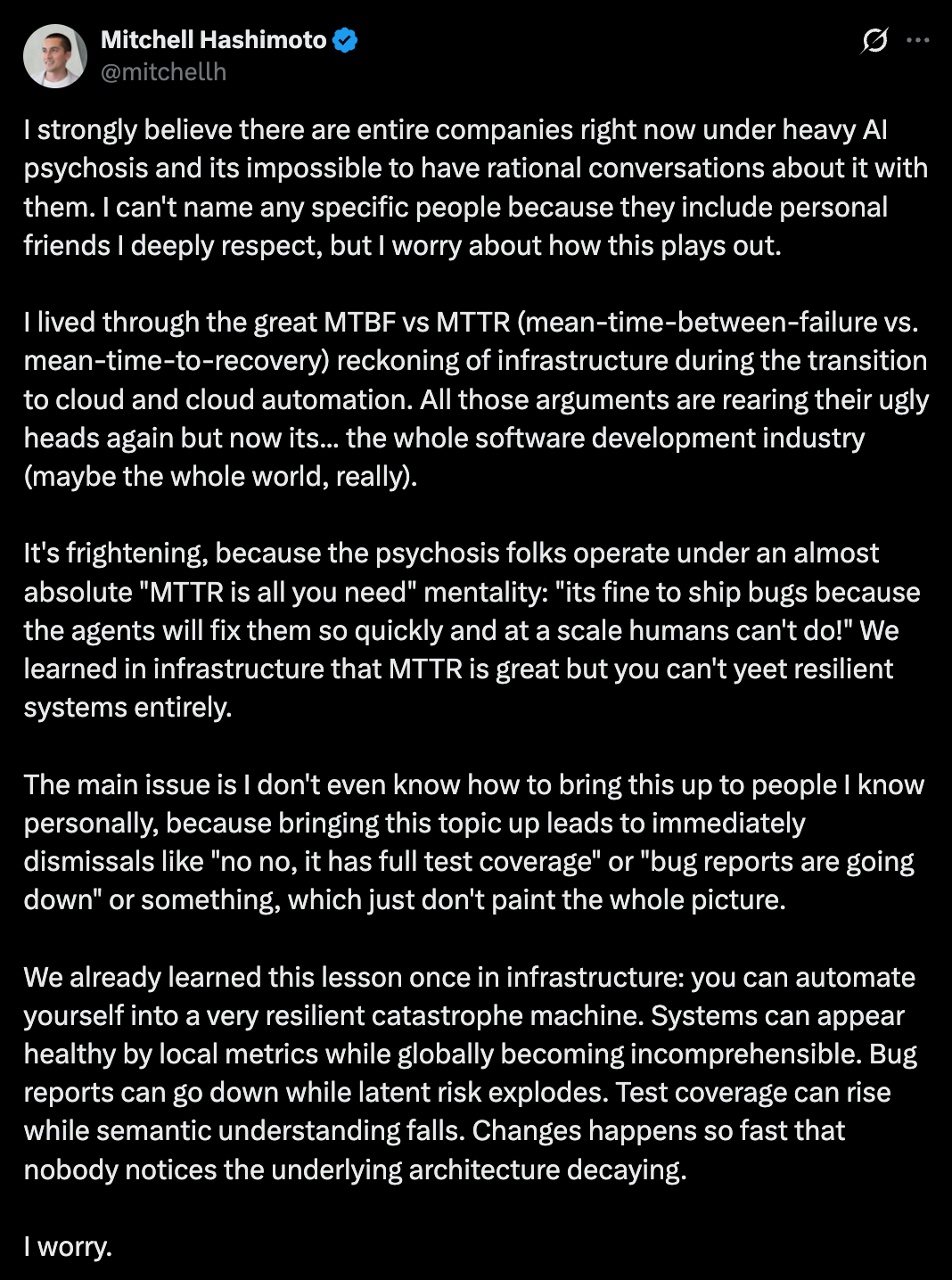
It’s the engineer’s obligation to walk the middle path. To be able to see the technological marvel that LLMs are, but think about the second and third-order effects of their application.
That’s where true virtue is.
I came across this talk yesterday, and I found it refreshing. It’s a level-headed take about how the industry is changing, devoid of hype, cynicism, or praise.
It’s an engineer’s take.
This is how I expect people to think about technology. This talk raises the question of whether companies can withstand an order-of-magnitude increase in code output:
You cannot produce so much code and rely on the same culture, strategy, and infrastructure that you currently have.
Code is a liability. Every engineer knows this. Ten times more code means a tenfold increase in liability.
Do we have the documentation to teach our agents the caveats about our domain and systems? How are we going to review their work at scale?
An increase in the code output means more pipeline runs, more tests, more resources, more merges, and more deployments. Do we have the infrastructure for that? Do we have the culture to support it?
Producing orders of magnitude more code will force us to rely more and more on end-to-end tests. How happy are you with your e2e test suite?
How are we going to ensure security at such a scale? What precautions do we have to take?
The DORA State of AI study shows that teams with good engineering fundamentals get the most benefit out of AI, while in others, it just amplifies their lack of understanding. What knowledge are we investing in?
All interesting points to think about.
I’m not half the developer that Mitchell Hashimoto or Adam Bender is, but when I see the bright minds of our field saying that fundamentals matter, I tend to listen.
No one knows where the field is headed and how we will be building software in twenty years. In the 2000s, we were shipping software on CD-ROMs, and they’re non-existent now.
But I do know that I need to have a good answer to the questions above.
The most important fundamental point -- and one which is likely much more difficult to optimize away than questions of water and efficiency -- remains, IMO, the question of the human intellectual harness. From where will it come now?
Almost every engineer I've spoken to about AI views themselves in the "not a junior, and thank God, because juniors are fucked" mentality. Largely due to a lack of jobs, but there's usually also a recognition that the juniors who can find jobs are now going to have all of their learning opportunities ripped away from them by being forced to be AI-first.
None of these engineers, however, view themselves as liable to become juniors once more, as the skills they've built up are no longer reinforced and their ability to pilot the AI regresses. Few seem to want to consider that their hard-won accomplishments of skill are, in fact, hard-won and *hard-maintained*.
My fear, and I don't think it's an irrational one, is that we are actively choosing to cannibalize the very harness which gives value to the cannibalization machine.